
DSA (Dynamic Spectrum Access)
DSA is a set of technologies and protocols that enable RF systems to dynamically change how they access spectrum. DSA is traditionally centered around frequency agility (i.e., dynamically selecting a communications channel) but can also include dynamic selection of other waveform modes such as bandwidth, power, modulation, and coding. SSC was the first company to demonstrate a DSA network as part of a DARPA field experiment in 2006. We have continued to innovate and mature our DSA capabilities for over 20 years and maintain DSA techniques and capabilities that are beyond simple interference avoidance algorithms that are emerging in some radio solutions today.
SSC’s DSA is an embedded software capability that enables radios to autonomously adapt their waveforms for resilience and performance based on RF and network conditions. Operationally, a network planner uploads a set of spectrum usage rules (aka “spectrum policies”) onto a radio prior to operation.
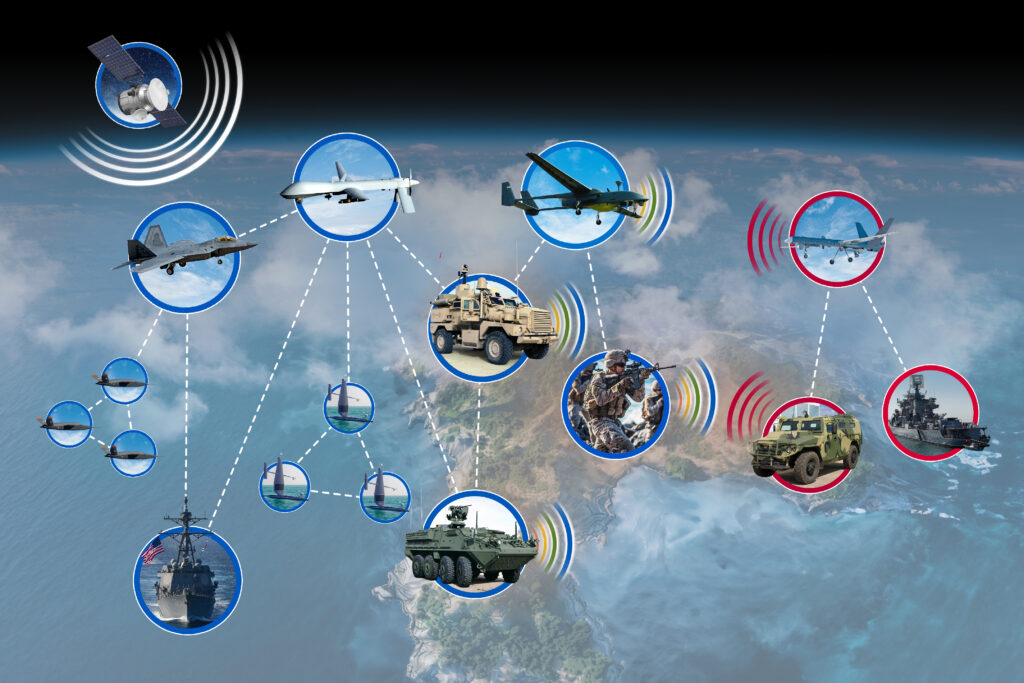
SSC’s Dynamic Spectrum Access capability provides controllable and adaptive RF for resilient wireless networking in dynamic and contested spectrum environments for multi-domain operations.
These rules act as “guardrails” that reflect spectrum management decisions regarding what parts of the spectrum are available to the radios, in what geographic areas, for what time period, etc. Once deployed, DSA senses the spectrum ranges of interest and makes coordinated frequency and mode selections based on the observations and spectrum policies.
Our DSA capability builds on the foundation of frequency agility and expands into dynamic mode selection (e.g., bandwidth, spreading, power). Not all waveforms or radios support every adaptation mode, so SSC’s DSA is customizable to the degrees of freedom and adaptation supported by the host radio and waveform.
SSC continues to advance its DSA capabilities in a number of areas:
- Portability: SSC’s DSA is designed to port to nearly any COTS SDR or tactical radio. We have integrated DSA onto numerous radio platforms and waveforms in various R&D projects: L3Harris PRC-163 with TSM waveform, Thales PRC-142, Northrop Grumman Freedom 310 with WNW waveform, Collins TTNT. SSC’s approach is unique, as emergent interference adaptive solutions appearing on the marketplace are tied to the radio and waveform vendor’s hardware and software.
- Flexibility: SSC’s DSA is designed to support a range of adaptive spectrum techniques and is customizable to the host radio, waveform, and mission characteristics. One example is our ARCUS (Autonomous Resilient Communications for Unmanned Systems) implementation, which provides a “virtually unjammable” sUAS datalink by employing a combination of DSA techniques that take advantage of RF conditions unique to contested UAS operations. We also have protocols unique to mesh networks that ensure node connectivity in contested RF.
- Controllability: SSC’s DSA solution is designed to provide assured controllability. Our solution embeds a “spectrum reasoner” into the real-time decision algorithms that governs what spectrum the radio can use. It ensures any spectrum adaptation decision complies with sets of spectrum policies imposed on the radio’s operation by authorities such as spectrum managers and mission commanders. These rules can be updated mid-mission by pushing new rule sets to the DSA-enabled radios over the network, effectively re-configuring the DSA systems on the fly. The rules provide guardrails for
- Extensibility: SSC’s DSA is designed to support new adaptation techniques and algorithms as capabilities and technologies evolve. We maintain a pipeline of DSA advancements to enable new adaptation techniques, algorithms, and protocols based on customer needs, emerging mission requirements, and advancements in radio and waveform capabilities. DSA software releases are updated and become available for integration as new capabilities are implemented. Our pipeline includes efforts to expand waveform mode adaptations, enable dynamic waveform selection, support multi-transport adaptation (e.g., auto-PACE).
- Resiliency: SSC’s DSA implements its adaptation decisions using a decentralized protocol. Each radio in the network provides input to the decision process, and any radio can act as the primary coordinator. This approach provides resiliency against network disruption should any node drop from the network.
- Performance: SSC’s DSA enables wireless networks to improve performance in congested and contested RF environments. By combining multiple spectrum adaptation modes, SSC’s DSA provides increased access to spectrum in in congested and contested RF, increases radio link ranges in the presence of jamming and other signal disruptions, enables radios to maximize bandwidth within constrained spectrum, and facilitates reduced RF signatures when combined with other obfuscation strategies.
Further information is available by contacting SSC at dsa@sharedspectrum.com.
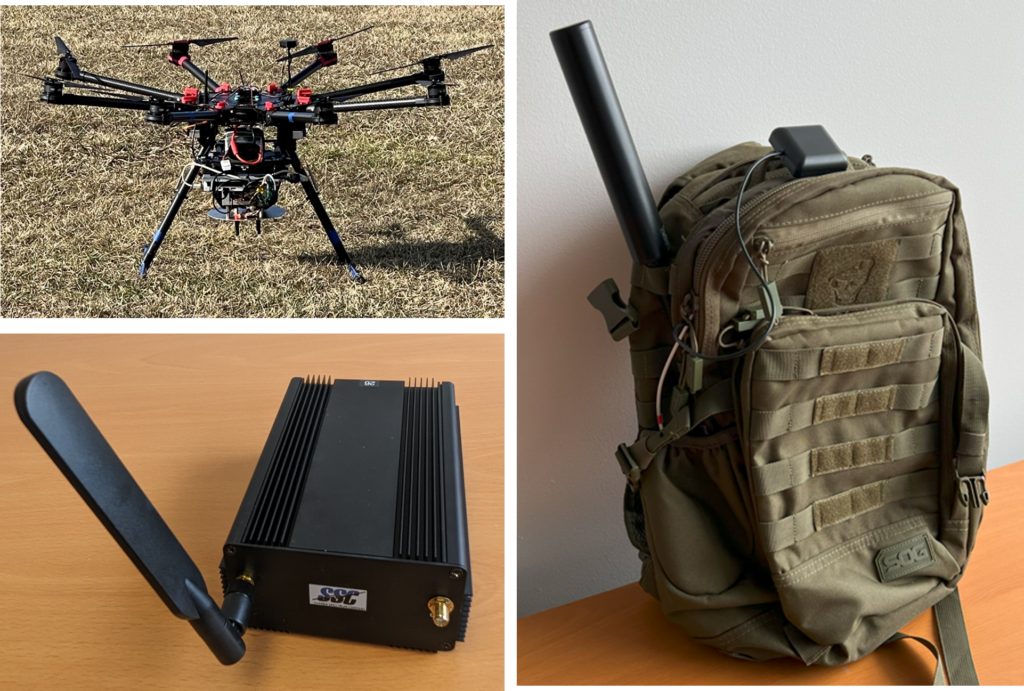
SSC’s DSA Capability has been integrated on multiple COTS and Tactical Radio Platforms, flown on small UAS for counter C-UAS operations, and tested in mounted and dismounted operations supporting resilient tactical networking.
ARCUS (Autonomous Resilient Communications for Unmanned Systems)
ARCUS is an instantiation of SSC’s DSA that is designed specifically for sUAS operations in contested RF environments. ARCUS implements adaptive RF and waveform capabilities that take advantage of UAS operational characteristics. Ongoing testing has demonstrated significant link resilience gains that produce greatly-increased link ranges, traffic throughput, and link up time compared to other techniques.
As with SSC’s broader DSA capabilities, ARCUS is designed to be portable across different host radios and waveforms. Our current prototype uses a COTS SDR that provides a low-cost platform for development, experimentation, and demonstration. We are leveraging our past collaborations with radio vendors to secure partnerships for deploying ARCUS on radio platforms meeting tactical deployment requirements.
Further information is provided on the Vulcan-SOF platform and via email at arcus@sharedspectrum.com.
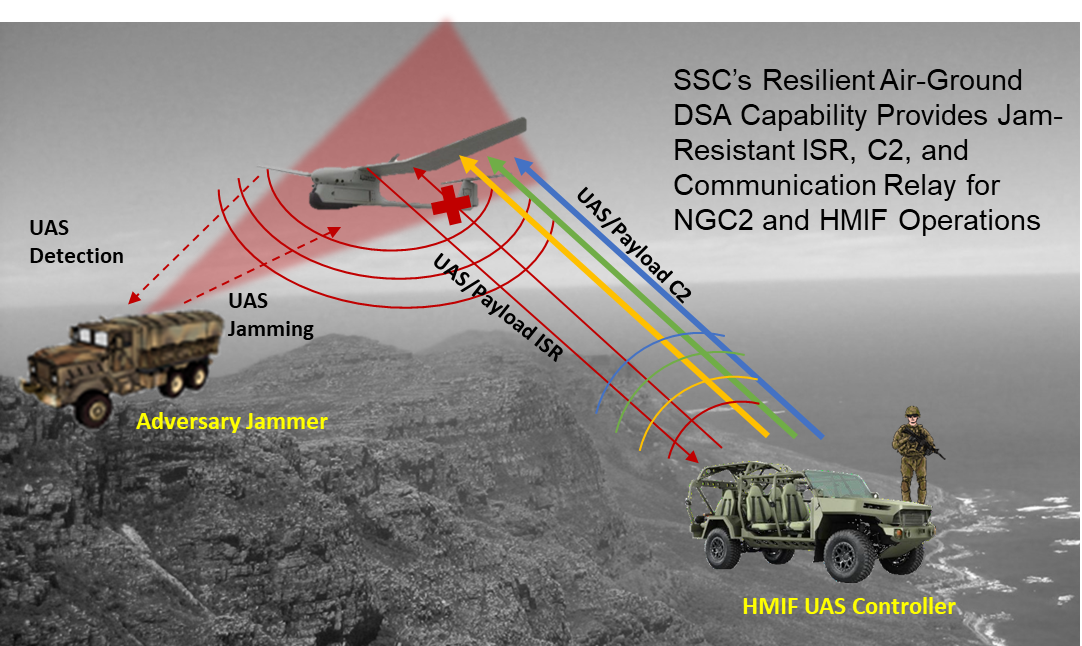
SSC’s ARCUS decouples UAS uplink and downlink frequencies via Hybrid TDD/FDMA and applies Dynamic Spectrum Access (DSA) in contested and congested RF to enable resilient ISR, Assured Mission Command, and Robust Communications Relay/Extension.
TEEMS (Tactical Edge EMS Maneuver System)
TEEMS provides the protocols and data products to enable orchestrated spectrum maneuver across tactical communications, EW, and sensing systems for establishing tactical edge Spectrum Dominance. TEEMS gives commanders the ability to attain freedom of EMS access and maneuver while obfuscating, confusing, disrupting, and denying the adversary. TEEMS leverages SSC’s policy-based spectrum control concept developed for its DSA solution to establish a spectrum C2 capability for all configurable and adaptive tactical RF systems.
The TEEMS capability extends adaptive communications and EW functionality beyond the current highly-centralized operations to one that implements centralized planning with distributed execution by embedding automated adaptation and sensing in edge RF systems and providing user tools that produce actionable SA capabilities across echelons and formations.
TEEMS enables offensive and defensive spectrum operations with distinct characteristics:
- Agile Rapid EMS Maneuver: Systems must rapidly adapt to congested and contested EMS conditions at a pace that exceeds that of our adversary
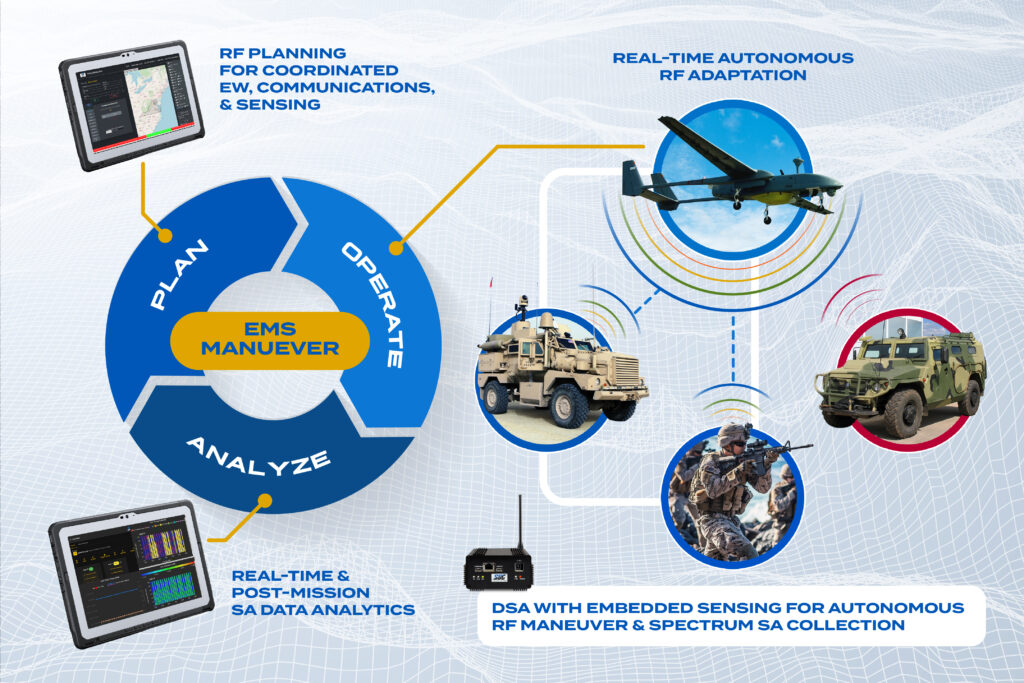
TEEMS provides a novel, disruptive approach to establishing Spectrum Dominance at the tactical edge by jointly enabling adaptive Networking at the Edge (operating in complex/contested environments) and Electronic Warfare (offensive and defensive EW for spectrum dominance).
- Distributed Coordinated Operations: Operations must collaborate and orchestrate across systems and functions (radio, EW, and sensing) without relying on central C2 provided by a fixed TOC.
- Controllable, Flexible, and Configurable: Systems must be rapidly and remotely reconfigurable to meet changing mission needs. Solutions must enable Army units to tailor their implementation to fit a range of TTPs.
- Interoperable and Evolvable: Solutions must enable interoperability and collaboration across different system types, including accommodating for legacy systems. Solutions must provide for continued evolution of technologies, techniques, and implementations